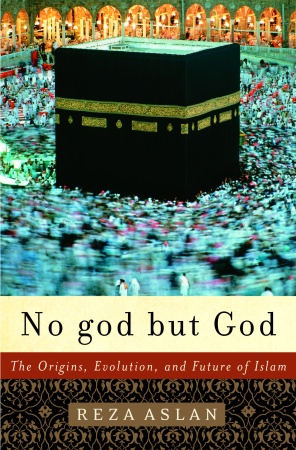
 No
god but god
No
god but god
No
god but god
The origins, evolution, and future of Islam
2006, Random House,
Prologue, xxvii
…it is possible to trace how Muhammad’s revolutionary message of moral accountability and social egalitarianism was gradually reinterpreted by his successors into competing ideologies of rigid legalism and uncompromising orthodoxy, which fractured the Muslim community and widened the gap between mainstream, or Sunni, Islam and its two major branches, Shiʻism and Sufism. Although sharing common sacred history, each group stove to develop its own interpretation of the scripture, its own ideas on theology and the law, and its own community of faith. And each had different responses to the experience of colonialism in the eighteen and nineteen centuries. Indeed, that experience forced the entire Muslim community to reconsider the role of faith in modern society. While some Muslims pushed for creation of an indigenous Islamic Enlightenment by eagerly developing Islamic alternatives to Western secular notions of democracy, others advocated separation from Western cultural ideals in favor of the complete “Islamization” of society. With the end of colonialism and the birth of the Islamic state in the twentieth century, these two groups have refined their arguments against the backdrop of the ongoing debate in the Muslim world over the prospect of forming a genuine Islamic democracy. But as we shall see, at the center of the debate over Islam and democracy is a far more significant internal struggle over who gets to define the Islamic Reformation that is already under way in most of the Muslim world.
The reformation of Christianity was a terrifying process, but it was not,
as it has so often been presented, a collision between Protestant reform and
Catholic intransigence. Rather, the
Christian Reformation was an argument over the future of the faith—a violent,
bloody argument that engulfed
Thus far, the Islamic Reformation has proved no
different. For most
of the Western world, September 11, 2001, signaled the
commencement of a worldwide struggle between Islam and the
West—the ultimate manifestation of the clash of civilizations.
From the Islamic perspective, however, the attack on
p. 28
…
p. 33-34
…Muhammad was a twenty-five-year-old man, still unmarried, with no cpital and no business of his own, who relied entirely on his uncle’s generosity for his employment and his housing. In fact, his prospects were so depressingly low that when he asked for the hand of his uncle’s daughter, Umm Hani, she rejected him outright for a more prosperous suitor.
Things changed for Muhammad when he attracted the attention of a remarkable forty-year-old widow named Khadija….
…he was renown for his generosity and the evenhandedness
with which he conducted his business….he seemed to be acutely aware of his
complicity in
Then, one night in 610 C.E., as he was meditating on
p. 41, 44
…His message was simple:…”free the slave”…”feed others in times of famine”…
This was a radical message, one that never been heard before in
…
…by proclaiming himself “the Messenger of God,” Muhammad was blatantly transgressing the traditional Arab process through which power was granted. This was not authority that had been given to Muhammad as “the first among equals.” Muhammad had no equals.
p. 52-53
“Muhammad in
Today,
As with all mythologies of this magnitude,
it is often difficult to separate factual history from sacred history.
Part of the problem is that the historical traditions dealing with
Muhammad’s time in
MDA:
In short, everybody tries to reach or emulate a model that nobody is sure
that is the right model.
***********************************************************************
p. 58
…whereas power in the tribe was allocated to a number of figures, none of whom had any real executive authority, Muhammad instead united all the pre-Islamic positions of authority into himself. He was not only the Shaykh [mda: tribe’s leader, the president] of his community, but also his Hakam [mda: judge, the Supreme Justice], its Qaʻid [mda: Commander in Chief], and as the only legitimate connection to the Divine, its Kahim [soothsayer, Prophet]. His authority as Prophet/Lawgiver was absolute.
MDA:
In short, Muhammad was the first dictator in human society.
************************************************************************
p. 66
…the veil was neither compulsory
nor, for that matter, widely adopted until generations after Muhammad’s death,
when a large body of male scriptural and legal scholars began using their
religious and political authority to regain the dominance they had lost in
society as a result of the Prophet’s egalitarian reforms.
p. 69
This…point bears repeating.
The fact is that for fourteen centuries, the science of Quranic
commentary has been the exclusive domain of Muslim men.
And because each one of these exegets inevitably brings to the Quran his
own ideology and his own preconceived notions, it should not be surprising to
learn that certain verses have most often been read in their most misogynist
interpretation. Consider for
example, how the following verse (4:34) regarding the obligations of men toward
women has been rendered into English by two different but widely read
contemporary translators of the Quran.
The first is from the Princeton edition, translated by Ahmed Ali; the
second is from Majid Fakhry’s translation, published by
Men are the support of women [qawwamma
’ala an-nisa] as God gives some more means than others, and because they
spend of their wealth (to provide for them)…..As for women you feel are averse,
talk to them suasively; then leave them alone in bed (without molesting them)
and go to bed with them (when they are willing).
Men are in charge of women, because Allah has made some of them excel the
others, and because they spend sme of their wealth….And for those [women] that
you fear might rebel, admonish them and abandon them in their beds and beat them
[adribubunna].
Because of the variability of the Arabic language, both of these translations are grammatically, syntactically, and definitionally correct. The phrase qawwamma ’ala an-nisa can be understood as “watch over,” “protect,” “support,” “attend to,” “look after,” or “be in charge of “ women. The final word in the verse, adribubunna, which Fakhry has rendered as “beat them,” can equally mean “turn away from them,” “go along with them,” and, remarkably, even “have consensual intercourse with them.” If religion is indeed interpretation, then which meaning one chooses to accept and follow depends on what one is trying to extract from the text: if one views the Quran as empowering women, then Ali’s; if one looks to the Quran to justify violence against women, then Fakhry’s.
p. 73
Today, throughout the Muslim world, a whole new generation
of contemporary female textual scholars is reengaging the Quran from a
perspective that has been sorely lacking in Islamic scholarship.
Beginning with the notion that it is not the moral teachings of Islam but
the social conditions of the seventh-century
p. 84
…perhaps the most important innovation in the doctrine of jihad was its outright prohibition of all but strictly defensive wars. “Fight in the way of God those who fight you,” the Quran says, “but do not begin hostilities; God does not like the aggressor” (2:190). Elsewhere the Quran is more explicit: “permission to fight is given only to those who have been oppressed…who have been driven from their homes for saying ‘God is our Lord’” (22:39; emphasis added).
It is true that some verses in the Quran instruct Muhammad and his followers to “slay the polytheists wherever you confront them” (9:5), to “carry the struggle to the hypocrites who deny the faith” (9:73); and, especially, to “fight those who do not believe in God and the Last Day” (9:29). However, it must be understood that these verses were directed specifically at the Quraysh and their clandestine partisans in Yathrib—specifically named in the Quran as “the polytheists” and “the hypocrites,” respectively—with whom the Ummah was locked in a terrible war.
Nevertheless, these verses have long been used by Muslim and non-Muslim alike to suggest that Islam advocates fighting unbelievers until they convert. This view was put forward during the height of the Crusades, and partly in response to them, by later generations of Islamic legal scholars who developed what is now referred to as “the classical doctrine of jihad”: a doctrine that, among other things, partitioned the world into two spheres, the House of Islam (dar al-Islam) and the House of War (dar al-Harb), with the former in constant pursuit of the latter.
p. 85
….the idea of killing nonbelievers who refused to convert to Islam—the foundation of the classical doctrine of jihad—not only defied the example of Muhammad but also violated one of the most important principles in the Quran: that “there can be no compulsion in religion” (2:256). Indeed, on this point the Quran is adamant. “The truth is from your Lord,” it says; “believe it if you like, or do not” (18:29). The Quran also asks rhetorically, “Can you compel people to believe against their will?” (10:100). Obviously not; the Quran therefore commands believers to say to those who do not believe, “To you your religion; to me mine” (109:6).
MDA: Well, when I read the verses cited above in their full, I find them confusing. Usually those who do not worship are threatened with the flames of fire. So, you allow them to not believe, but you threaten them with punishment, anyway. I do not see in such a situation “no compulsion.”
p. 94
…Muslim law, which considers Jews and Christians “protected peoples” (dhimmi), neither required not encouraged their conversion to Islam. (Pagan and polytheists, however, were given a choice between conversion and death.)
MDA:
First, I do not see in this tolerance, I see double standard.
Why pagans and polytheist would be excluded from understanding and
tolerance and be given only the choice of conversion or death?
Second, during the Ottoman yoke of
p. 103
It is no coincidence that just as they reversed many of Muhammad’s social reforms aimed at empowering women, the Muslim scriptural and legal scholars of the following centuries rejected the notion that Jews and Christians were part of the Ummah, and instead designated both groups as unbelievers. These scholars reinterpreted the revelation to declare that the Quran had superseded, rather than supplemented, the Torah and the Gospels, and called on Muslims to distinguish themselves from the People of the Book. This was largely an attempt to differentiate the nascent religion of Islam from other communities so it could establish its own religious independence, much as the early Christians gradually dissociated themselves from the Jewish practices and rituals that had given birth to their movement by demonizing the Jews as the killers of Jesus.
Nevertheless, the actions of these scriptural scholars were in direct defiance of Muhammad’s example and the teachings of the Quran. For even though Muhammad recognized the irreconcilable differences that existed among the People of the Book, he never called for a partitioning of the faiths.
p. 113-114
…”the Successor to the Messanger of God”—Caliph, in English.
…the Caliph would be responsible for upholding the institutions of the Muslim faith, but he would not play a significant role in defining religious practice. In other words, Abu Bakr would replace the Prophet as leader of the Ummah, but he would have no prophetic authority. Muhammad was dead; his status as messenger died with him.
The deliberate ambiguity of his title was a great advantage for Abu Bakr and his immediate successors because it gave them the opportunity to define the position for themselves, something they would do in widely divergent ways.
….
As we shall see, the Ummah would eventually fashion a comprehensive code of conduct meant to regulate every aspect of the believer’s life. And while it would be a mistake to consider these religious clerics and scholastic theologians as constituting a single, monolithic tradition, the power of the Ummah and their influence in shaping the faith and practice of Islam cannot be overstated. Caliphs will come and go, and the Caliphate as a civil institution will rise and fall in strength, but the authority of the Ummah and the power of their religious institutions will only increase with time.
p. 114
As Caliph, Abu Bakr united the community under a single banner and initiated a time of military triumph and social concord that would become known in the Muslim world as the Golden Era of Islam. It was Abu Bakr and his immediate successors—the first four Caliphs who were collectively referred to as the Rashidun, the “Rightly Guided Ones”—who tended the seed Muhammad had planted in the Hijaz until is sprouted into a dominant and far-reaching empire.
…..
As with most sacred histories, however, the truth about the era of the Rightly Guided Ones is far more complicated than the traditions suggest. Indeed, the so-called Golden Era of Islam was anything but a time of religious concord and political harmony. From the moment Muhammad died, there arose dozens of conflicting ideas about everything from how to interpret the prophet’s words and deeds to who should do the interpreting, from whom to choose as leader of the community to how the community should be led. It was even unclear who could and could not be considered a member of the Ummah, or, for that matter, what one had to do to be saved.
p. 136
The Caliphate…was an office that developed not so much
through the conscious determination of the Rightly Guided Caliphs, but as the
result of conditions that the Ummah encountered as it matured from a tiny
community in the Hijaz to a vast empire stretching from the
p. 139
Throughout Islamic history, as
Muslim dynasties tumbled over each other, Muslim kings were crowned and
dethroned, and Islamic parliaments elected and dissolved, only the Ummah, in
their capacity as the link to the traditions of the past, have managed to retain
their self-imposed role as the leaders of Muslim society.
As a result, over the past fourteen centuries, Islam as we know it has
been almost exclusively defined by an extremely small, rigid, and often
profoundly traditionalist group of men who, for better or worse, consider
themselves to be the unyielding pillars upon which the religious, social, and
political foundations of the religion rest.
How they gained this authority, and what they have done with it, is
perhaps the most important chapter in the story of Islam.
p. 153-154
By the ninth and tenth centuries, this debate over determinism and free will was loosely divided between two major strands of thought: the so-called “Rationalist position,” most clearly represented by the Muʻtazilite school, and the “Traditionalist” position, dominated by the Ashʻarite school. The Rationalist Ulama of the Muʻtazilah argued that God, while fundamentally indefinable, nevertheless exists within the framework of human reason. Challenging the notion that religious truth could be accessed only through divine revelation, the Muʻtazilah promulgated the doctrine that all theological arguments must adhere to the principles of rational thought. Even the interpretation of the Quran and the traditions, or Sunna, of the Prophet were, for the rationalists, subordinate to human reason.
……
The Ashʻari argued that human reason, while certainly important, must nevertheless be subordinate to the Quran and the Sunna of the Prophet. If religious knowledge could be gained only through rational speculation, as the Muʻtazilah claimed, there would be no need for prophets and revelations; the result would be a confusion of theological diversity that would allow people to follow their own wills rather than the will of God. The Ashʻari considered reason to be unstable and changing, while the prophetic and scriptural traditions—especially as they were defined by the Traditionalist Ulama—were stable and fixed.
p. 158-159
The debate between the Rationalist and the Traditionalist Ulama continued for a few hundred years, with each school alternating in influence, until the end of the thirteenth century, when, partly in response to al-Ma’mun’s disastrous Inquisition, the Traditionalist position became the dominant position in Sunni Islam. Most Rationalist were branded as heretics, and their theories gradually lost influence in all major schools of law and theology with exception of the Shiʻite schools…And while the debate over the nature of the Quran continues to this day, the influence of the Traditionalists interpretation has led to a number of extraordinary theological and legal developments in Islam.
For instance, belief in the eternal, uncreated word of God has led to the widespread conviction among Muslims that the Quran cannot be translated from its original language. A translation into any other language would remove the direct speech of God, rendering it an interpretation of the Quran, not the Quran itself. … Muslims of every culture and ethnicity must read the Quran in Arabic, whether they understand it or not.
p. 161
For the rationalists, who reject the notion of an uncreated Quran, the only reasonable method of exegesis was one that accounted for the temporal nature of the Relevation. For this reason, the Rationalists stressed the primacy of human reason in determining not just the essence of the Quran, but also its meaning and, most importantly, its historical context. To the Traditionalists, the eternal and uncreated nature of the Quran made it pointless to talk of historical context or original intent when interpreting it. The Quran has never changes and will never change; neither should its interpretation.
….What was appropriate for Muhammad’s community in the seventh century C.E. must be appropriate for all Muslim communities to come, regardless of the circumstances. This view of the Quran as static and unchanging became increasingly problematic as the revelation gradually transformed from merely the principle of moral guidance in the Muslim community to the primary source of Islam’s Sacred Law: the Shariah.
p. 163-164
Developing the
Shariah
The Sunna is composed of thousands upon thousands of stories, or hadith, that claim to recount Muhammad’s words and deeds, as well as those of the earliest Companions. …as these hadith were passed down from generation to generation, they became increasingly convoluted and inauthentic, so that after a while, nearly every legal or religious opinion—no matter how radical or eccentric—could be legitimated by the Prophet’s authority. By the ninth century, the situation had gotten so out of hand that a group of legal scholars, working independently of one another, attempted to catalogue the most reliable hadith into authoritative collections…
The primary criterion by which these collections were authenticated was the chain of transmission, or isnad, that often accompanied each hadith.
…
…their method lacked any attempt at political or religious objectivity. The bulk of what are considered to be sound traditions were deemed so not because their isnads were particularly strong, but because they reflected the majority beliefs and practices of the community. In other words, the hadith were collected, and the Sunna developed, specifically to create a sense of Islamic orthodoxy and orthopraxy by legitimizing those beliefs and practices that were already widely accepted by the majority of the Ulama, and eliminating those that were not. While some hadith may in fact contain an authentic historical core that can be traced back to thea Prophet and his earliest Companions, the truth is that the Sunna is a far better refection of the opinions of the ninth-century Ulama [Is’lam’s cleric establishment] than of the seventh-century Ummah [Muslim community in Medina].
….
Reliable or not, the Sunna was grossly inadequate for addressing the myriad legal issues that arose as Islam expanded into an Empire. A number of other sources had to be developed to cope with those concerns not expressly dealt with in the Quran and the Sunna. Chief among these was the use of analogical arguments, or qiyas, which allowed the Ulama to draw parallels between their community and Muhammad’s when responding to new and unfamiliar legal dilemmas. Of course, analogies can be stretch only so far and, in any case, the Traditionalists-dominated schools of law were wary of placing too much emphais on reasoning over Revelation. So while qiyas remained a vital tool in the development of the Shariah, the Ulama ultimately grew far more dependent on the fourth source of law, ijma, or “juridical consensus.”
Relying on the Prophet’s saying that “my community will never agree on an error,” the Ulama posited that the unanimous consensus of the legal scholars of a particular age on a particular issue could create binding legal decisions, even if those decisions seemed to violate Quranic prescriptions (as was the case with the practice of stoning adulterers). Like the Sunna, ijma was developed specifically to create orthodoxy among the Muslim community. But more importantly, ijma served to consolidate the authority of the Ulama as the sole determiners of acceptable Muslim behavior and beliefs.
….
…eventually the consensus of one
generation of scholars became binding for successive generations,
with the result that the Ulama gradually became
less concerned with developing innovative solutions to contemporary legal
problems and more occupied with what in Islam
is referred to derisively as taqlid—the
blind acceptance of juridical precedent.
One other major source of law must be mentioned. During the formative stages of the Shariah, it was commonly believed that when the Quran and the Sunna were silent on an issue, and if analogy and consensus had failed to deliver a solution, a qualified legal scholar could use his own independent juristic reasoning to issue a legal ruling, or fatwa, which could then be accepted or rejected by the community as they wished. Know as ijtihad, this was an absolutely vital source of the law until the end of the tenth century, when the Traditionalists Ulama, who at that time dominated nearly all the major schools of law, outlawed it as a legitimated tool of exegesis. The “closing of the gates of ijtihad,” as this action has been called, signaled the beginning of the end for those who held that religious truth, as long as it did not explicitly contradict the Revelation, could be discovered through human reasoning.
p. 166
The Ulama associated with these [four main schools in modern Sunni world] entrenched themselves as the sole authority of acceptable Islamic beliefs. As these schools of thought gradually transformed into legal institutions, the diversity of ideas and freedom of opinion that characterized their early development gave way to rigid formalism, strict adherence to precedent, and an almost complete stultification of independent thought, so that even by the twelfth century, Muslim thinkers … began decrying the Ulama….complaint against the Ulama is as applicable today as it was nine hundred years ago.
p. 169
…with Muhammad’s death, the Revelation ceased.
But that does not mean that the Ummah stopped evolving.
On the contrary, the contemporary Muslim community—nearly a billion and a
half strong—bears almost no resemblance to the small community of faith that
Muhammad left behind in seventh-century
Nevertheless, the heirs of Traditionalism have managed to silence most critics of reform, even when that criticism has come from their own ranks.
p. 170
The problem is that it is practically impossible to
reconcile the Traditionalist view of the Shariah with modern conceptions of
democracy and human rights. Any
modern Islamic state has only three alternatives for incorporating the Shariah
into its legal systems. It can
accept the Shariah as a legitimate source of civil law, but choose to ignore it
in all but most obvious family, divorce, or inheritance cases, as
For more than twenty years, the Islamic Republic of Iran has been struggling to reconcile popular and divine sovereignty in an attempt to construct a genuinely Islamic democracy dedicated to pluralism, liberalism, and human rights. It has been a difficult, violent, and hitherto unsuccessful endeavor.
…..
Of course,
p. 179
p. 184-185
…The Jafari school…differentiates itself from Sunni schools of law, first by recognizing a different set of hadith, which include stories of the Imams as well as of Muhammad, and second by vigorously employing ijtihad, or independent juristic reasoning, as one of the primary sources of Shiʻite jurisprudence. … To this day, Shiʻite law maintains the conviction that “whatever is ordered by reason, is also ordered by religion,”…
…only those who have attained the very highest level of
scholarship and who can boast the greatest number of disciples are still allowed
to practice ijtihad. At the top of
this order…are the ayatollahs (the
title means “the sign of God”), whose decisions are binding on their disciples.
Only a handful of authoritative ayatollahs exist today—primary in
p. 189
…the Iranian revolution of 1979 was the inevitable
conclusion of two previous popular revolutions—the Constitutional Revolution of
1905-11 and the Nationalist revolution of 1953—both of which were suppressed by
foreign governments (the first by the Russians and, to a lesser extent, the
British; the second,…by the United States) who wished to maintain their grip on
Iran’s natural resources. By the
late 1970’s, most Iranians had grown so weary of the corrupt and ineffective
rule of
p. 191
Khomeini argued that in the absence of the Mahdi, divine guidance could come only from the Hidden Imam’s representative on earth: that is, the Ulama. Khomeini was not the first Shiʻite theologian to have made this claim; the same idea was formulated at the turn of the twentieth century by politically minded clerics…But the Valayat-e Faqih [Khomeini ideology] proposed two startling modifications to the traditional Shiʻite doctrine. First, it insisted that absolute authority be concentrated in the hands of a single cleric, instead of all qualified clerics. Second, it argued that, as the deputy of the Mahdi, the supreme cleric’s authority was identical to that of the “Hidden Imam.” In other words, Khomeini’s guidance was, like the guidance of the prophet and the twelve Imams, infallible and divinely inspired.
….Khomeini wrote in his historic political treatise, Islamic Government,“ he [the qualified jurist] will enjoy all the rights in the affairs of the society that were enjoyed by the Prophet.”
p. 192
…what made Khomeini so alluring was his ability to couch
his theology in the populist rhetoric of the time.
He thus reached out to
….the Valayt-e Faqih merely replaced one form of tyranny with another.
p. 226-227
In 1877, Sayyid Ahmed Khan
founded the
p. 230-231
…Ideals such as social egalitarianism, popular sovereignty, and the pursuit and preservation of knowledge had their origins not in the Christian Europe, but in the Ummah. It was Muhammad’s revolutionary community that had introduced the concept of popular sanction over the ruling government while dissolving all ethnic boundaries between individuals and giving women and children unprecedented rights and privileges.
…
…the Ulama bore the responsibility for the decline of
Islamic civilization. In their
self-appointed role as the guardians of Islam, the Ulama had so stifled
independent thought and scientific progress that even as
But al-Afghani was no member of the
p. 232
…Abdu called for the reopening of the gates of ijtihad, or independent reasoning. The only way to Muslim empowerment, he argued, was to liberate Islam from the iron grip of the Ulama and their traditionalist interpretation of the Shariah. Like Sir Sayyid, Abdu demanded that every man-made source of law—the Sunna, ijma, qiyas, and the like—must be subject to rational discourse. Even the holy Quran must be reopened to interpretation, questioning, and debate from all sectors of Muslim society. Muslims do not need the guidance of the Ulama to engage the sacred Revelation, Abdu argued, they must be free to experience the Quran on their own.
While Abdu did not believe that Islam need separate its religious ideals from the secular realm, e categorically rejected the possibility of placing secular powers in the hands of religious clerics, whom he deemed totally unqualified to lead the Muslim community into the new century.
p. 239
Not to be confused with Pan-Islamism, the supernationalist theory of
Muslim unity under a single Caliph, Islamism called for the creation of an
Islamic state in which the sociopolitical order would be defined solely
according to Muslim values. The
Islamists argued that Islam is a comprehensive ideology that governs all aspects
of the believer’s life. As Qutb
wrote, the fundamental concern of Islam is “to unify the realm of earth and the
realm of heaven in one system.” The
primary condition for the realization of that system would be the adoption and
implementation of the Shariah in the public sphere.
Western secular values must be rejected in the Muslim world because Islam
forbids its theological beliefs to be “divorced in nature or in objective from
secular life and customs.” All
secular governments, therefore, including those run by Arabs like
…radicalized members of the Muslim Brothers who had managed to escape Nasser’s wrath found refuge in the only place that would open its arms to them: Saudi Arabia, a country on the verge of an economic explosion that would transform its rough band of tribal leaders into the wealthiest men in the world—an astounding achievement for a kingdom founded a little more than a decade earlier as the result of an informal alliance between an insignificant tribal Shaykh and a barely literate religious zealot.
p. 242-3
…Abd al-Wahhab called for a return to the unadulterated
Muslim community established by Muhammad in
As Hamod Algar has pointed out, hat it not been for the extraordinary
circumstances under which Wahhabism emerged, it would undoubtedly have “passed
into history as a marginal and short-lived sectarian movement.”
Not only was this a spiritually and intellectually insignificant movement
in a religion founded principally upon spiritualism and intellectualism, it was
not even considered true orthodoxy by the majority of Sunni Muslims.
Yet Wahhabism had two distinct advantages that would guarantee its place
as the most important sectarian movement in Islam since the Penitents first
gathered at
p. 243-4
The facts of the alliance between
Ibn Saud and Abd al-Wahhab have given way to legend.
The two men first met as Abd al-Wahhab and his disciples were tearing
through the
“This oasis is yours,” Ibn Saud promised; “do not fear your enemies.”
Abd al-Wahhab replied with an unusual demand. “I want you to grant me an oath,” he said, “that you will perform jihad against the unbelievers [non-Wahhabi Muslims]. In return you will be leader of the Muslim community, and I will be leader in religious matters.”
Ibn Saud agreed, and an alliance was formed that would not only alter the
course of Islamic history, it would change the geopolitical balance of the
world. …
They [Wahhab’s warriors] sacked the treasury of the Prophet’s Mosque in
p. 245-6
..
….
…The Saudis offered all the money, support, and security
the Brothers needed to fight back against secular nationalism in their home
countries. But the Muslim Brothers
discovered more that shelter in
…In 1962, their missionary efforts gained momentum with the creation of the Muslim World League, whose primary goal was the spread of Wahhabi ideology to the rest of the Muslim world. This was, in effect, the new Islamic expansion…
…
Since the creation of the Muslim World League, the simplicity, certainty, and unconditional morality of Wahhabism have infiltrated every corner of the Muslim world. Thanks to Saudi evangelism, Wahhabi doctrine has dramatically affected the religio-political ideologies of the Muslim Brothers, Mawdudi’s Islamic association, the Palestinian Hamas, and Islamic Jihad, to name only a few groups. The Saudis have become the patrons of a new kind of Pan-Islamism: one based on the austere, uncompromising, and extremist ideology of Islamic fundamentalism, which has become a powerful voice in deciding the future of the Islamic state.
p. 248
Despite the tragedy of September
11 and the subsequent terrorist acts against Western targets throughout the
world, despite the clash-of-civilizations mentality that seized the globe and
the clash-of-monotheisms reality underlying it, despite the blatant religious
rhetoric resonating throughout the halls of governments, there is one thing that
cannot be overemphasized.
What is taking place now in the Muslim world is an
internal conflict between Muslims, not an external battle between Islam and the
West.
The West is merely a bystander—an unwary yet complicit casualty of a
rivalry that is raging in Islam over who will write the next chapter of its
story.
p. 255
In many ways, the partition of
p. 257
The experience of
p. 262-3
Islam has had a long commitment to religious pluralism. Muhammad’s recognition of Jews and Christians as protected peoples (dhimmi), his belief in a common divine text from which all revealed scriptures are derived (the Umm al-Kitab), and his dream of establishing a single, united Ummah encompassing all three faiths of Abraham were startlingly revolutionary ideas in an era in which religion literally created borders between peoples. And despite the ways in which it has been interpreted by militants and fundamentalists who refuse to recognize its historical and cultural context, there are a few scriptures in the great religions of the world that can match the reverence with which the Quran speaks of other religious traditions.
It is true that the Quran does not hold the same respect for polytheistic
religions as it does for monotheistic ones.
However, this is primarily a consequence of the fact that the Revelation
was revealed during a protracted and bloody war with the “polytheistic” Quraysh.
The truth that is the Quran designation of “protected peoples” was highly
flexible and was routinely tailored to match public policy.
When Islam expanded into